Friday, March 11, 2016

too many C H O I C E S

...If this isn't the best meme you have ever seen, I don't know what is!

Back to having too many choices... I was listening to Pandora Radio this morning and I heard a funny add that related directly to having too many options as consumers! Jensen Jewelers was advertising engagement rings. They were marketing their hundreds of different rings, for every budget, all with 14 different financing options. 14 financing options!!! In "The Paradox of Choice," Schwartz poses the idea that having too many choices can lead to uncertainty, regret, and a struggle to make a decision. I think this is exactly what will happen when a man walks into Jensen Jewelers.

Most people will not ever miss the choices they don't even know they have, but it is easy to regret the choice that you made. As consumers, we think more choices will lead to a more definite decision because we see everything there is and are able to choose from all of them. Contradictorily, it only makes the decision making process worse.

The following video talks about the scientific part of having to make choices and highlights a phenomenon known as decision fatigue. This states that no matter how small or large the decision, choices causes anxiety - even in win win situations where there is no 'wrong' choice! He also discusses decision paralysis, which is when consumers get overwhelmed by too many choices and they end up not making a choice all together. This is a great five minute clip to talk about the downfalls of too many choices!


And there we have it... Too many choices is stressing us out and causing us to be bad decision makers. So next time you are faced with a choice, narrow your options and don't think about it again once your decision is made.

Thursday, March 10, 2016

M A X I M I Z I N G or satisficing?

In Barry Schwartz' book titled "The Paradox of Choice," he elaborates on our everyday choices and  expands on the idea of maximizers versus satisficers. Schwartz defines a maximizer as someone who seeks and accepts only the best. On the opposite end of the scale is a satisficer - someone who is willing to settle for something that is good enough and not worry about the possibility that there might be something better. The picture below is a good representation of the process each one goes through, as well as the outcome of their choices. 


The last two days I found myself being the ultimate maximizer - and it is frusturating! My boyfriend and I were visiting a new city and when we got into town it was about lunch time. We were both hungry and neither had a preferance, just food. As we walked the streets of downtown, there were multiple restaurant options that looked good. We weren't to the end of the street yet and the hunger grew, but what if there was something better at the other end?! So we continued walking. Before long we reached the last place on the last corner of main street. We thought this had to be the place so we walked in and it was nothing like we thought. There was about three menu options (none of which were appealing), so we walked back outside and the search continued. In the end, we ended up eating at the first restaurant we saw because it looked to be the best option. By the time we got our food, we were hardly hungry anymore and the quality of the meal was extremely low, leaving us both very dissapointed.

I thought after reading this book and becoming aware of the downfalls of being a maximizer, I would surely not make this mistake any more. I was wrong. It is so easy to think there must be something better, and continue a search for something, even though what is right in front of us satisfies the need.

It is important to become aware of these things to avoid pitfalls, however it is not foolproof. We are all humans and as humans we easily sink into habits - whether its a habit of being a maximizer or a satisficer.

Monday, March 7, 2016

Z M E T

The Zaltman Metaphor Elicitation Technique is a way to discover what consumers are really thinking about something. As consumers, we often don't know the full reason for the decisions we make - we just make them subconciously. The following video is a great down and dirty description of the ZMET technique and how it was formed.


I love how Jerry Zaltman discovered his technique by seeing that people in Nepal subconciously took photos without any feet in them, since bare feet are a sign of poverty in Nepal. I found this interesting because we often do this sort of thing in our daily life without realizing it. We all have 'insecurities' that we do not want to convey - so we do everything we can to not show them.

The fact that we subconciously hide insecurities, is evidence enough for me that we often subconciously make buying decisions. Our assumptions, preconceived ideas, biases, and many other things affect our buying decisions and very little of it is actually based on the product or service itself.  If marketers and producers can get inside the head of their consumers, such as the ZMET allows, they can better understand exactly what is desireable. The Zaltman Metaphor Elicitation Technique is a very useful qualitative research technique that allows marketers to gain an insight into how consumers’ subconscious minds work. It will allow them to better satisfy the needs of consumers and reach an exact market.


Thursday, March 3, 2016

H E U R I S T I C S in our lives

A heuristic is a rule or method used to solve problems faster than you would if you did all of the computing. We do not have time to make long drawn out decisions about everything we do in our lives, or we would just spend the whole day making a few decisions. Heuristics are also known as a "rule of thumb" when it comes to making decisions.

Below is an example of the scarcity heuristic... you may find that you also succumb to this!


I found this picture to be funny because it is such a good representation of how we make decisions in our lives. Without even realizing it, we so easily succumb to the scarcity heuristic. The scarcity heuristic states when an object or a resource is less readily available, we perceive it as more valuable. Just like these oranges; when they were "ordinary" oranges, nobody was buying them, when "deal of the day" was added to the basket, more people were drawn in, and when "best selling oranges" was also added, they were gone in no time. 

Researchers Worchel, Lee, and Adewole discovered that by placing the exact same cookies in two of the exact same jars, one containing ten cookies and the other containing two, consumers were more likely to choose a cookie from the jar containing less. This experiment was done in 1975, and still holds very true today. They found consumers valued the scarce cookies more because they got the impression that they must be the better cookies, or else so many people wouldn't have bought them. It did not matter if the cookies were exactly the same - the scarce ones appear to look at taste more appealing. Tricky! 


Do you find yourself doing the same thing when making a decision between several alternatives??

Marketers are very knowledgeable about the various heuristics that exist - which gives them the upper hand when appealing to consumers. They are better able to label products, place them in the perfect spot, and increase the appeal to a product that has not actually changed. This doesn't mean it is necessarily used in a negative manner, in fact it is our job as consumers to be aware of the heuristics that exist and make decisions based on facts. 


Resources:
http://www.behavioraleconomics.com/mini-encyclopedia-of-be/scarcity-heuristic/
http://www.nirandfar.com/2013/07/psychology-of-scarcity.html

Wednesday, February 17, 2016

consumer V U L N E R A B I L I T Y

It amazes me how dominating our thoughts and perceptions are over all of the decisions we make and the way we reason through things. In Predictably Irrational, by Dan Ariely, there were examples of our irrationality having to do with everything from social and financial norms to deciding which brand of pain reliever to purchase. Not only do we reason through things using our prior experiences, but also the biases of other people’s experiences – causing us to be extremely vulnerable to outside influences.

Consumer vulnerability was proved in the yogurt and wine experiments. In the yogurt experiment, everyone believed they were eating strawberry yogurt simply because that is what they were told they were eating. Even the girl who was not told until after eating it, and originally did not taste any strawberry, was mislead by the perception of the others. Preconceived ideas of what something is supposed to taste like has a very strong impact on what we actually taste. As for the wine experiment, just like the pain reliever example in Predictably Irrational, the price of products has an extremely significant impact on the satisfaction we gain from consuming it. This is proof that we are inherently irrational and our biases have a large affect on our perception as consumers and as marketers.

I think that both perception and bias influence ethics and honesty. On a greater scale than yogurt tasting, marketers can easily be influenced by other things happening in the market. For example, if a competing company alters the truth of a product just a little bit, then other companies are more likely to justify telling a little white lie as well, because everyone else is doing it too. This allows ethics to be altered and honesty to be downplayed. Another example that questions ethics from Dan Ariely’s book was the placebo surgery experiment. Although doctors were not doing anything to make the patients condition worse, they wanted to find out if not doing anything could make it better. Is using someone’s life as an experiment really ethical? What if they still are cured because of the mental power of believing they were operated on, then does it make it okay?

There are no right and wrong answers to these questions – only perceptions.


For further information about the examples provided above, refer to the following videos and book:

Predictably Irrational by Dan Ariely

Friday, February 12, 2016

what is P E R C E P T I O N?

PERCEPTION: an approximation of reality; the ability to see, hear, or become aware of something through the senses; a way of regarding, understanding, or interpreting something; a mental impression.

Perception is a funny thing. Take the above definitions for example - they are all meanings of the word 'perception'. If five people read all of the definitions above and choose the one that resonates with them the most, it is very likely that all five people will not choose the same definition. There may be a couple of the same, but even looking at the definition of perception, our perceptions of what makes the most sense varies. It is a beauty of life that we all have the ability to see through our own eyes and make decisions based on our perceptions.

Amit Sodha, author of Unlimited Choice and the article Perception Vs Reality (link below), poses the question - "can anything be classed as real when our perceptions differ greatly on so many things?" With this question in mind, I find reality to be a puzzling idea. There is no handbook as to what is right and wrong, good and bad, pretty and ugly, etc. Art is a perfect example of this - one person can see the beauty of a piece, while another will think it is average, and think another piece is more beautiful. That is why it is so interpretive and about each person's perception of beauty. If we all see something differently, how can there truly be a reality of what it is or is not?

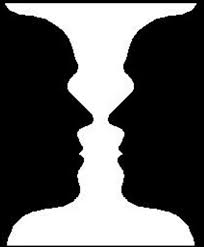
One way to explain the idea of perception better, is to physically see how different two people can perceive the same image. Below are a few examples.


Where are his legs?

Two faces or an hourglass?

The face of a scarecrow or woman in a dress?

I also find it fascinating that when we look at a picture, our mind quickly forms an image. Only when we really study the picture are we also able to see the other image hidden within. This is very much like life; we all have opinions and perceptions, and only when we really let go of our own idea and put ourself in someone else's shoes are we able to understand the way they see it. It requires us to empty our own cups in order to fill it with someone else's information. If we dont first empy our own, it simply overflows and nothing new is discovered.

We will always perceive things differently than those around us, in order to understand the reasons behind our own perceptions, we must learn how to see things from other peoples perspective and let go of our preconceived ideas of the ways things are or should be.

"We see the world not as it is, but as we are." - Talmud

Link to the blog that sparked my fascination:
http://www.unlimitedchoice.org/blog/meditations/perception-vs-reality/

Monday, February 8, 2016

the power of E M P A T H Y

More often than not as humans we immediately form an opinion or make judgement about another person, without really knowing their story. We think we can tell so much by how someone carries themselves, how they dress, how they talk, or what their interests are. Seldom do we get to know where somebody came from and all of the little things that add up to make them who they are, before we decide what we think their life is all about.

Recently I was staring this situation directly in the face.
There is a lady that I have spent several days around, only having small spirts of conversations with here and there, but otherwise many hours in each other's presence. She is strong, passionate, kind, full of love and full of life. Her energy radiates to everyone in the room and her smile and laughter could make an army weak at the knees.

I had no idea. 

I had no idea the hurt she really feels, the struggles she faces every single day just to get out of bed, the strength she must possess at all times to get through each day, and so much more. I found myself pulled in like a magnet at the start of her story, not having any idea where it would lead. It began with a simple question of "why" that I asked, just because I was curious. I had no idea she was longing for someone to listen and just feel for her. All she wanted in that moment was for someone to feel a little empathy.

I think that we have all been in a situation like this before where we must distinguish between sympathy and empathy. People don't always need us to feel bad for them. They simply need us to feel for them. 

Webster's Dictionary defines empathy as the feeling that you understand and share another person's experiences and emotions; the ability to share someone else's feelings. I find the picture below to be a strong visual representation of empathy and what it looks like to obtain it.

http://www.merriam-webster.com/dictionary/empathy


Empathy is powerful in relationships as well as advertising. It's that little piece that pulls on everyone's heartstrings and makes us all feel a little less like 'the only one.' It doesn't matter if you are buying a particular product or having a rough day; empathy is a powerhouse in so many situations in our world and in order to use it to it's full potential, we must first bridge the gap between you and me.